


KNOWLEDGE ATLAS / TEACH

What does this pupil response tell you?

Consider the decisions that make teaching purposeful — from explaining an idea to responding thoughtfully to what learners reveal.

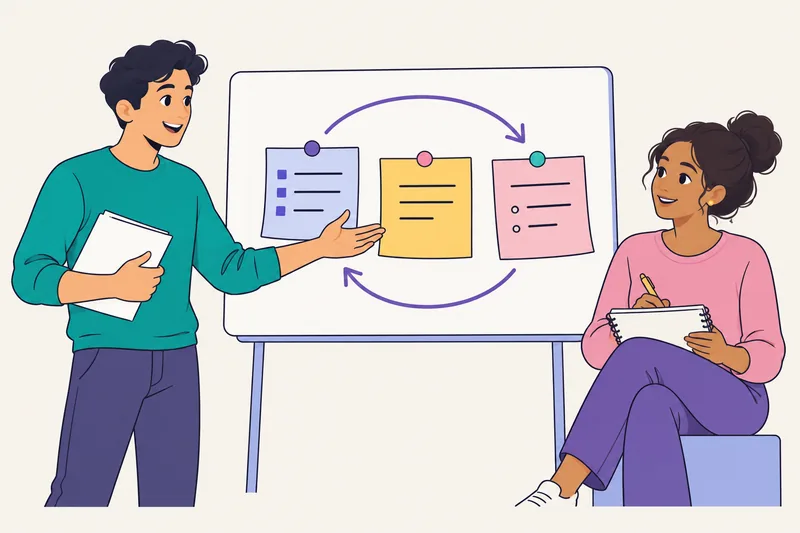
Two educators discuss a feedback cycle while one takes notes.

TEACH / EVIDENCE IN PRACTICE

Feedback needs somewhere to go.

Before writing another comment, consider what the learner will be able to do with it. The Education Endowment Foundation’s feedback guidance focuses on underlying principles rather than choosing written feedback over spoken feedback.

An illustrative classroom move

A pupil’s paragraph makes a claim but offers no supporting example. Instead of simply writing “more detail”, point to the claim, ask for a relevant example and provide time to revise that sentence. Then inspect whether the example actually supports it.

This is a suggested application, not proof of effectiveness. The right next step depends on the task, the pupil’s understanding and the learning goal. Sometimes the pupil needs further teaching before they can use a comment.

Source: Education Endowment Foundation (2021), Teacher Feedback to Improve Pupil Learning. The paragraph example is original TeachBox guidance.

Choose a practical next step

A PRACTICAL NEXT ACTION

What will this classroom move help you notice?

Ask pupils for an answer and the reason behind it. Give thinking time and compare two responses before deciding what to explain next.

Adapt the move to age, language, prior knowledge and the purpose of the lesson.

Ideas for your teaching practice.

01 / PROFESSIONAL PRACTICE

Teaching practice

A teaching move needs a purpose, a context and something observable to look for.

F03 / Teach It Tomorrow / INTRODUCTION

Try one teaching move with context and adaptation.

A practical starting point

Ask pupils for an answer and the reason behind it. Give thinking time and compare two responses before deciding what to explain next.

Adapt the move to age, language, prior knowledge and the purpose of the lesson.

Explore the existing introduction

02 / PROFESSIONAL PRACTICE

Assessment & feedback

Look closely at the work before deciding what the learner can use next.

Read: Feedback needs somewhere to go.

Before writing another comment, consider what the learner will be able to do with it. The Education Endowment Foundation’s feedback guidance focuses on underlying principles rather than choosing written feedback over spoken feedback.

An illustrative classroom move

A pupil’s paragraph makes a claim but offers no supporting example. Instead of simply writing “more detail”, point to the claim, ask for a relevant example and provide time to revise that sentence. Then inspect whether the example actually supports it.

This is a suggested application, not proof of effectiveness. The right next step depends on the task, the pupil’s understanding and the learning goal. Sometimes the pupil needs further teaching before they can use a comment.

Source: Education Endowment Foundation (2021), Teacher Feedback to Improve Pupil Learning. The paragraph example is original TeachBox guidance.

03 / PROFESSIONAL PRACTICE

Classroom strategies

Choose a prompt that reveals reasoning and gives the learner a way to respond.

F06 / The Better Question / INTRODUCTION

Use questioning to reveal reasoning and new possibilities.

A practical starting point

Replace “Do you understand?” with “Which step is easiest to explain, and which still needs an example?” Use the responses to choose your next explanation.

A richer prompt needs time, accessibility and a response format learners can use.

Explore the existing introduction

04 / PROFESSIONAL PRACTICE

Curriculum & lesson decisions

Connect the objective, the learning sequence and the evidence you will inspect.

F12 / TeachBox Lessons / INTRODUCTION

Develop complete adaptable instructional blueprints.

A practical starting point

Start by specifying the objective, prerequisite knowledge and an observable learning check. Then align teacher actions, student actions and what to look for.

This is an introduction to the lesson-design framework, not a complete F12 lesson or a tested classroom resource.

Explore the existing introduction

05 / PROFESSIONAL PRACTICE

Professional learning

Separate recognition from independent recall, and keep application within the scope of the explanation.

Read: Close the page. What stays with you?

Looking at a familiar explanation and reconstructing it without looking are different tasks. Retrieval practice asks you to bring previously learned information back to mind.

A review by Kathleen B. McDermott describes evidence that practising retrieval can support later remembering across a range of materials and learning settings. That does not make every quiz equally useful, or recall a complete measure of understanding.

A practical starting point

  1. Read a short explanation that you can broadly understand.
  2. Close it. Write the main idea and one example from memory.
  3. Compare with the source, correct errors and identify a gap.
  4. Return later and try again, with a suitable prompt if needed.

Try explaining how the example illustrates the idea. Remembering words and using a concept deserve separate checks.

Evidence: McDermott, K. B. (2021), Practicing Retrieval Facilitates Learning. The sequence above is TeachBox practical guidance, not a tested intervention.

Keep the territories connected.

Explore all four territories Teaching practice